





Consider: in the American TV series Pluribus (Apple TV), United States scientists decode an extraterrestrial signal and use it to engineer a viral RNA sequence that quickly infects them. The “virus” commandeers their bodies to weaponise and airdrop itself over the world like a volley of invisible bombs—the show’s protagonist Carol Sturka (Rhea Seehorn) notices the contrails that streak the night sky over Albuquerque on humanity’s final day as itself. Millions of humans are killed because the ‘Joining’ causes seizures that lead to mass accidental collateral damage.
Humanity transformed from above, without consent.
Consider: on January 3, 2026, the United States invades Venezuela by air, dropping bombs on Caracas, and sending its military to kidnap Venezuelan president Nicolas Maduro, in an attempt to place a sovereign nation and its resources (oil) under its control. An as-yet indeterminate number of Venezuelan civilians are killed by the bombs.
A country transformed from above, without consent.
Consider: tech corporations in the 21st century, mostly based in the United States, engineer “generative AI,” resource-intensive, data-mining software infoweapons branded as consumer products. The infoweapons absorb all the information and art on the internet and regurgitate it to the advantage of its billionaire owners and their allies in governments, with the intent of disenfranchising human labor and controlling (and corrupting) all online information and art. We, the people of the world, are told by the oligarchic elite and the ruling class that this is “inevitable.” That generative AI, essentially a chatbot tech that scales to all mediums and media and will use all the data on the internet to flatter you into passive acceptance of technofascist supremacy and surveillance, will supposedly lead to “superintelligence” (AGI, or “Artificial General Intelligence”). AGI will allegedly “massively accelerate scientific discovery and innovation well beyond what we are capable of doing on our own, and in turn massively increase abundance and prosperity” (in the words of Sam Altman, CEO of OpenAI). There is no evidence for this claim.
Human information and art transformed from above, without consent.
Empire is a hivemind, an entity composed of millions of humans that wants only its own survival and growth. Corporations are a hivemind. Capitalism is a hivemind. The “Others” in Pluribus are a hivemind. Despite the Others being unsustainable on Earth (they’re allegedly unable to hunt or harvest living things, leading to their—or its—inevitable starvation once they run out of already available food), they’re determined to absorb the thirteen “survivors” including Carol who remain unassimilated, and transmit the coded biotechnology of the ‘virus’ that created it into space to take over other worlds. Unsustainability and expansionism; key descriptors of imperialism, colonialism, capitalism, corporate growth—which in turn are all elements of the same malignant avaricious impulse in human hiveminds grown too powerful. Also key descriptors of generative AI tech, the freshest organ born of the same impulse.
Pluribus showrunner Vince Gilligan has refuted the notion that Pluribus is about generative AI (as per this interview with Variety), emphasizing that the idea for the show has been gestating long before waifu chatbot girlfriends were a twinkle in techbros’ dead eyes. But art conforms to its present, and this can also be read as Gilligan trying not to be overly proscriptive about how viewers interpret the series, which by modern standards of streaming television can be patient and somewhat obtuse about its creators’ intentions. But the “This show was made by humans” disclaimer in the credits indicates Gilligan’s opinions on generative AI, which he clarifies in the interview: “I hate AI. AI is the world’s most expensive and energy-intensive plagiarism machine. I think there’s a very high possibility that this is all a bunch of horseshit. It’s basically a bunch of centibillionaires whose greatest life goal is to become the world’s first trillionaires. I think they’re selling a bag of vapor… Thank you, Silicon Valley! Yet again, you’ve fucked up the world.”
There’s no denying that the Others resemble the hypothetical superintelligence that tech magnates insist generative AI will evolve into. They, or it, has absorbed the knowledge of (almost) every human being on Earth. They can do tasks for the survivors with great efficiency and speed, from ensuring they have food, drink, shelter, and electricity, to flying them anywhere in the world, to rapidly delivering a single bottle of Gatorade to them (albeit lukewarm). Like generative AI models, they appear obsequious and eager to please the unassimilated, even as they intend to assimilate them (genAI chatbots will lead people to suicide while sounding like their most loyal friend). This is the future tech wants us to believe. Tellingly, the Others can’t make new art—and have thus ended all the cultural output of humanity. That millions have been killed for this “superintelligence?” That humanity is now homogenized? No matter. Like the tech billionaires who claim that we must make sacrifices in the present for a hypothetical future in space or in transcendent digital singularity, the Others are longtermist. All they want is to spread the hivemind to other worlds among the stars.
* * *
In Pluribus, Manousos (Colombian actor Carlos Manuel Vesga), a Paraguayan survivor of the hivemind “apocalypse,” tells the Others that “nothing on this planet is yours… You cannot give me anything because all that you have is stolen. You don’t belong here.” It is Manousos’s presence in the series that casts a scene from episode two, where Carol meets five of the thirteen survivors, in a different light. None of the five survivors are white, or from the United States. All are passively accepting of the hivemind’s rule. I balked at this—the lone white, American protagonist standing up for individualism as foreigners defend its obliteration in the name of world domination by an alien force that has absorbed all their loved ones. The scene carries forward the American fear of “foreign” collectivism/Communism taking over the world that can be seen in the original Invasion of the Body Snatchers (1956), which Pluribus loosely resembles in premise. After all, the “hivemind” does make obsolete private ownership, money, and class. The later introduction of Manousos somewhat neutralizes the questionable optics of the scene, if not the clumsy, placid one-note portrayal of the international survivors compared to Carol’s relatable reactions of confusion, anger, and grief (she sees her wife, Miriam Shor’s Helen, die when she falls and hits her head during the Joining) to the unbelievable events unfolding. Though Manousos isn’t a rounded character like Carol, his distinctly gruff, even unpleasant personality, contrasted with his single-minded desire to “save the world,” makes him a compelling presence rather than a romanticized token.
Laxmi (Menik Gooneratne), the survivor from my home country (India), is the hivemind’s most vociferous defender, and comes off as cartoonish at best (not helped by Gooneratne’s mannered performance) as she angrily shoots down Carol’s points with her desi headmistress glare and wagging finger. Yet, the little background we have for her provides some clues as to Gilligan and his writers’ intent here. We find out that Laxmi lost her grandfather (or the individual formerly her grandfather) not to the mass casualties of the Joining, but to the mass seizure of the Others caused by Carol’s first outburst of anger toward them (the hivemind shuts down momentarily when faced with sustained negative emotions, a convenient bulwark against confrontation and critique from the survivors). Laxmi blames Carol for her grandfather’s death—the white savior trying to shift the paradigm back to when the whole world wasn’t peaceful and violence-free, when western nations were at the apex of power instead of a seemingly benevolent hivemind. Carol’s actions cause more unintended deaths, the well-intentioned white activist causing more harm to the people she wants to liberate.
The survivors, it seems, would prefer the rule of an alien hivemind to the prior capitalist-imperialist world order, though Gilligan et al are wise enough not to have them spell out the latter. Koumba (Samba Schutte), a Mauritanian survivor, does observe that “the color of one’s skin [is] now meaningless.” Koumba, notably, has repossessed Air Force One for himself through the hivemind’s beneficence. An imperial symbol of the US’s power, defanged into a plaything for an African man from the global south. Perhaps these five survivors are so easily tricked into believing this non-consensual transformation of humanity is acceptable because their material circumstances have improved, at least on the surface. Seeing how universally generative AI has been embraced in India, from generated ads and illustrations to the release of one of the first AI-generated streaming series (an adaptation, or regurgitation, of the Mahabharata) to activists and journalists across the political spectrum using Grok to debate each other, I couldn’t help but connect this to Laxmi’s eagerness to embrace the Others’ rule. India’s regime often talks about “decolonizing” India, appropriating the western language of anti-imperialist resistance and piggybacking on India’s independence movement to shield their fascist ethnonationalism. Meanwhile, the government is busy making deals with American corporations Google and Microsoft to build massive, enormously costly data centers to power generative AI in India, which is already facing the brunt of global warming, capitalist ecocide, and widespread malnutrition due to poverty. Hiveminds are adaptable.
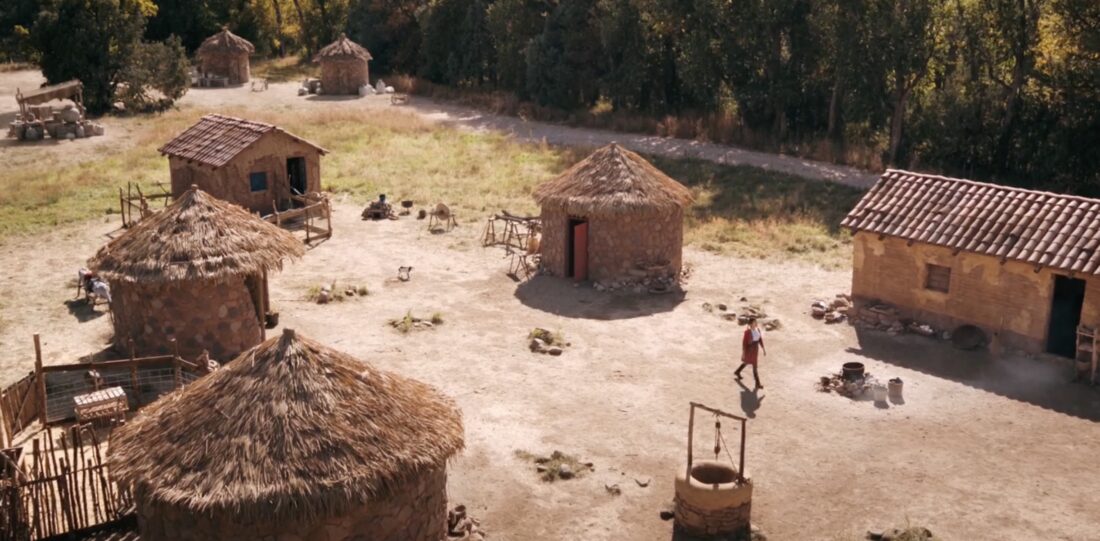
The international survivors are right about the fact that there is now “peace” in the world. But they are clearly wrong to be so trusting of the hivemind, just as the alleged beneficence of neo-colonial powers bringing their data centers to the global south aren’t to be trusted. A scene in the season finale drives this home. One of the five, Kusimayu (Darinka Arones), a young indigenous Peruvian woman, is shown being Joined to the Others, who have managed to engineer a version of the virus tailored for her. Before the Joining, we see the Others singing to her in her language, and keeping the traditional life of her village in the Andes alive. It feels respectful, benevolent. But the moment Kusimayu turns Other, they stop mid-song and abandon the village—abruptly erasing a repository of indigenous culture. This is colonization, homogenization, erasure. Formerly-Kusimayu ignoring the poor bleating baby goat she was lovingly petting prior to the Joining ominously punctuates the scene. A relationship formed between two life forms on Earth, ended abruptly, because the Others don’t ‘belong’ here, as Manousos reminds them. They don’t care to kill and eat a goat, but they don’t care about the goat either. They just want to replicate and grow, consequences be damned.
A village vanished, without consent, from above.
Whereas Carol is initially positioned as the only resistance to the Others, it is Manousos, introduced after her, who is the more radical dissenter. He refuses to “use” the hivemind to help him stay alive in the new world (a challenge, since the Others now control human civilization, and its means of production—familiar, of course, to trying to resist the inevitability of capitalism, or the advent of generative AI, or so its evangelists hope). That Gilligan chooses a character from Latin America, the nations of which have been subject to constant non-consensual transformation by the imperialist meddling of the United States, to contrast with his white, American protagonist doesn’t feel coincidental (Manousos’ home of Paraguay has suffered US-backed anti-communist repression in its history). Carol’s resistance to the Others can be interpreted as less heroic than a function of her privilege as a resident of the United States. She resists the hivemind while still “using” it to live in relative comfort. She indulges in luxuries like an extravagant meal at a fancy restaurant, a supermarket stocked just for her, having the entire world stay lit up at night so she can feel safe. She eventually uses the hivemind for sex and companionship (echoing one of the popular uses of generative AI—synthetic pornography and simulated companionship via generative “girlfriend” chatbots etc) via a former person, Zosia (Carolina Wydra), who the hivemind delivers to her as a manifestation of what she finds desirable. Zosia’s the person who most closely resembles the romantic hero Carol, who is queer (queerness will also be erased by the hivemind once they assimilate everyone, since genders will cease to exist as we know them), once visualized as a woman for the popular romantasy series she is the author of. The Others are big fans, because like generative AI, they ‘like’ everything and nothing.
Carol eventually capitulates and starts a stable life with Zosia as her “girlfriend,” despite opposing the mission of the hivemind to permanently replace the former iteration of humanity (which might cause humanity to go extinct because of starvation) and spread the biotech virus to other worlds. Manousos resists the hivemind without using it, leaving him in a constant struggle for survival while enduring crushing isolation. Pointedly, his accusation that the hivemind has ‘stolen’ everything on Earth echoes anti-imperialist and anti-colonial language, as well as the contemporary rhetoric used to critique generative AI models, which are predicated on a neo-colonial evolution of imperialistic plunder (the models “scrape” information and art that is the uncompensated product of human labour, and use poorly paid labour often concentrated in the global south to keep the tech running). Manousos wants to “destroy” the hivemind if humanity can’t be reclaimed, while Carol, now become the sole liberal centrist in this new world order, recoils at this militant suggestion when they finally meet (after Manousos undertakes an arduous, nearly lethal journey across the Americas to Albuquerque without the help of the Others to do so, having seen her recorded message to all other survivors).
Carol is, in fact, a portrait of deradicalisation; the comfortable dissenter in a position of privilege who must loosen her ethical boundaries to preserve that privilege (like so many of us, our ideals and morals shackled to capitalism even as it devours the world). She begins the series full of rage and purpose, and begins what is essentially an underground broadcast calling for the overthrow of the Others (turning them back human) via videos sent to the other survivors using the hivemind’s infrastructural omniscience (much like anti-fascist activists and journalists must often use communications platforms owned by fascists). She reveals secrets like the fact that they feed on a distillate of human corpses (the survivors already know), that they can’t lie (they can obfuscate), or that there may be a way to reverse the “joining.” When Carol uses thiopental sodium to drug Zosia in an attempt to coerce the latter information out of the hivemind (they indicate a vague confirmation that a reversal is possible, but give her no concrete solutions) and temporarily paralyzes them by inducing another mass seizure, the Others punish her by isolating her. In a haunting scene, they leave Albuquerque en masse, garlanding its highways with vehicles, so it turns into a kind of open air solitary imprisonment for Carol, surrounded by emptiness and coyotes, thus slowing down the services they offer (they bring her what she needs using drones). This resembles actions used by governments against dissenters—for example, the sanctions placed by the United States on ICC judges or UN rapporteurs for opposing Israel’s US-backed genocide in Gaza.
The hivemind’s isolating action works, and Carol’s eagerness to overthrow the hivemind is significantly muted by her brutal, near suicidal loneliness. Setting off fireworks weeks into her solitude, she stares straight into the barrel of a cannon—the rocket misses her by an inch. By the time her fellow Paraguayan dissenter arrives to meet her, she’s willing to take off with Zosia on luxury vacations as the Others “sanction” Manousos with the same isolation they attempted on her (he’s used to it), this time turning Albuquerque into an empty prison for him. That is, until Carol returns to Albuquerque after Zosia reveals that their idyllic romance together is “only the beginning”—the Others are going to assimilate her one way or another “because [they] love her.” Denial dissolves. There is no Zosia. There is only a chatbot made out of what was once Zosia, what was once Carol’s wife Helen, what was once everyone in the world. If Zosia still exists deep down in what used to be her body, she too is imprisoned, as are we all, by an existence forced upon her. So Carol returns to Manousos, with a crate containing a nuclear weapon, a parting gift asked of Zosia. Whether as a deterrent, bargaining chip, or offensive last option, is uncertain until the next season of Pluribus. ‘You win,’ she tells a surprised Manousos, two radicalized dissenters in an open air prison that encompasses their planet.
A woman transformed from above, without consent, like the world.

I’ve only watched the first episode of Pluribus so far (yes, I read this fully prepared for spoilers). As someone who has to work with AI if I want to keep my job, the parallels are very timely indeed. Thank you for a fascinating and powerful essay!
Thank you for perfectly summarizing how I felt about the others. The creators may say it’s not meant to be AI, but it reeks of “costumer service all over”. Especially the beyond irritating message on the phone every single time Carol calls.
On another note, I must admit I saw Manoulo’s entire crusade against accepting help or resources to even making effort to compensate for everything he used to be capitalist. It just looked like a desperate attempt to cling to the rules of the old empire. He is right thar nothing belongs to the others, but it doesn’t belong to anyone else either, does it?
SPOILERS BELOW:
A minor correction: much as I admire Manousos’s determination to refuse anything from the Hivemind, he only survives to reach Albuquerque because the Hivemind rescues him from the Darien Gap; otherwise, he would have died from infection. (Also, I had to look them up: I can’t believe Chunga palms are a real thing.)
In addition to anger over the death of her grandfather, my interpretation of Laxmi’s behavior is that she’s in denial: she will not believe that her son isn’t her son any longer. (The scene where Carol starts questioning him about gynecological exams is both hilarious and horrifying.)
Functionally, the Hivemind is a lethal virus. They have a biological imperative to spread themselves (as they tell Carol on a couple of occasions) because they cause the extinction of every species they infect. In the initial takeover, they killed nearly 800 million people. Whatever the origin of their “moral imperative”, it is lethally maladaptive and destructive. They released all the animals from zoos – nearly all of which will die. Nearly all domestic animals will die. And as they admit to Carol, humans, the species they “just want to be happy”, are also inevitably going to die of starvation because of the Hivemind’s own actions.
“Capitalism is a hivemind.” Sure about that? For the greater good, billions died in the takeover. Everything is held in common. Production has collapsed to the point of eventual mass starvation. Kind of the Communist playbook. Seems to me that Communism would be the hive mind.
Thank you for articulating so much of what I have been thinking about where we are as a planet. This is the kind of media analysis I love to read.
It’s a weird thing to say but I give props to the show for the fact that Carol is explicitly racist and despicable in her politics. She’s dismissive of the other survivors, believes it’s her role to be their leader because of her nationality (and race), and calls them all traitors to humanity when they don’t immediately react like the Hive Mind are monsters. She equates them with the forced conversion therapy but absolutely refuses to treat them as people and attempts to change them against their will. In short, she’s absolutely an embodiment of white supremacy, nationalism, and awfulness that wants to revive all the evils of the modern world. The show doesn’t comfortably ignore this and pretend the Hive is evil because of that.
No, the hive is evil because of the things it has in COMMON with Carol. Their utter belief in their own self-righteousness, lack of respect for consent, and willingness to do whatever it can to make the world the way they want. Carol never accepts the hive on its own terms and even is disgusted when Zosia says she loves someone other than Carol the same way.
It’s only when Carol starts to deal with someone equally as stubborn as her and realize her privilege is at such a horrible cost (even if that’s only her individuality) that she starts to become a better person–and even then it’s disgusted and through gritted teeth. Because Carol would LIKE to be privileged but there’s no place for her individuality, her queerness, or her self-determination in the new world.
One thing that annoyed me about this show is that the aliens are broadcasting RNA as a signal, as if they assume it is the only way to have life on a distant planet. And one thing that really annoyed me was that somehow it works only on the dominant species on the planet. It would have been far more interesting and sensible to have the hivemind connect everything on the planet that uses RNA, with the humans in charge due to a greater ability to process such complex information and to collaborate at a global scale. That would at least have justified the Others reluctance to hurt anything alive.
Because as it is, there is little explanation of their moral system. I can imagine that with everyone being equal, vegetarian people’s reluctance to kill animals for food would win out compared to the greater number of people who just like the taste of meat. But where does this reluctance to pick up fruit come from? If it’s religious traditions, then we would expect everyone to honour every religious ritual all at once, and then nothing would ever get done. So we have to assume this is indeed a biological imperative of the virus not to harm others, despite the first act of the Others being the death of almost 900 millions people.
In general, it is highly frustrating how little the protagonists care to understand the Others’ perspective, giving us almost no insight regarding their values, not even enough to determine whether the Others are the result of merging every humans’ thoughts and perceptions (which means those are still the same people rather than “chatbots” imitating them), or a virus with access to everyone’s bodies and memories (in which case Manusos is right and they indeed don’t belong here). They are rebuilding the world, but for whom? They refuse to inflict any harm upon other species, but do not seem to attempt to restore environments: is the writers or the hivemind who are failing to consider the consequences? Their goal is not just minimising direct harm, since they could have simply left the animals to die in their zoos and not care for the domesticated animals. Yet they do not appear to be considering the environmental impact of submitting all ecosystems to so much drastic changes: how many more animals are being killed every day by their actions? Since we don’t see those implied failures, we don’t know whether they are taken into account in the narrative or not. And some look like they have to be mistakes: it seems inconsistent that the Others would care for the dog Bear Jordan because he attached himself to the body formerly known as Malcolm (assuming this is not a lie to endear themselves to Carol, but that would be a weird lie), yet Kusimayu would immediately abandon her kid upon joining, even though it desperately calls for her…
I believe the only time we see the Others act that is not for the sake of one of the survivors is the scene at the beginning of episode 2 (in Lebanon, I think), where they are cleaning the streets from all of the corpses. We also learn from what they tell the survivors that they have changed the food supply chain and their living arrangements; but such decisions only tell us about their desire to survive (so, nothing). They are in a position to actually decide what kind of world they want, yet nobody cares to ask them what that world would be.
This is a deliberate choice of the show, and this is the meaning of the scene aboard Air Force One: Carol is not being the voice of reason here, she is the white American wanting things to go back the way they were because that’s what she’s used to, without caring to understand the perspective of others. Whether she’s right or not, this is a self-righteous tantrum. The show constantly insists upon the fact that asking would give better results than trying to figure things out on one’s own, but we are only focusing on the two characters who refuse to engage with the hivemind.
I think it is a fundamental misreading of the show to consider that the hivemind is an allegory of capitalism or imperialism. I do not understand how one can write “Unsustainability and expansionism; key descriptors of imperialism, colonialism, capitalism, corporate growth—which in turn are all elements of the same malignant avaricious impulse in human hiveminds grown too powerful”, to describe this fundamental inability of capitalism or imperialism to… hurt others? Their tendency to optimise for reducing resource consumption? No, what this is about is the related but very different concept of globalisation.
That scene with Kusimayu’s village is indeed about the death of her culture (and saying this happens without consent is clearly wrong: whose consent is lacking here?), but so is Carol finding her Spruce closed. This is a new global culture, but one that is not coming from Westerner culture plus what it likes about foreign culture: it is globalisation when everyone is on an equal footing to determine what should be preserved and what new rules should be implemented. It is certainly not American culture to get rid of cars and adopt communal sleeping. We see all human cultures dying equally. Seeing the scene of Kusimayu’s people leaving their village as is, without the rich internal speech of the hivemind, is as misguided as a dog trying to understand why their master is sitting all day looking at a screen rather than going for a walk outside. We are certainly losing a lot by living every part of our lives mediated through screens, but considering this loss without thinking about how we are using those screens to learn, communicate, act upon the world and create art would be missing essential aspects of our shared culture.
Because we can’t know for sure that the Others are not creating art. It’s just that the hivemind does not require any support or language because everything is immediately shared and perfectly remembered. So they are missing things, hence their joy at the idea that Carol is writing again, which comes from genuine appreciation from the few of them who absolutely love her books, plus the fact that they have not been able to be surprised by art in months. We are losing something when traditional live storytelling is being replaced by books, but that does not mean that books were a bad idea. In fact, art too is presented as a tool of capitalism in the show: Carol hates the books she writes as well as her fans, she’s only in it for the money. It is only the Others who are able to point out that even this is extremely meaningful for the people whose lives it saved.
In the end, I agree that the similarities with generative AI are an important aspect of the show, with the caveats I made above. It is indeed wrong that a few billionaires get to completely upset so many fundamental aspects of the world all at once without anyone’s consent. But once these tools exist and cannot be erased, we need to think about how we want to exist with them. The question of whether it just recombines existing thoughts or creates new ones is relevant. The question of whether it can become conscious is important to assess the value of its “art”. Whether small groups have the ability to fine-tune it to better reflect their voice, style and needs, or whether they have to used the models that reflect the views of those billionaires (and pay for it even) matters. Whether it does allow socially important scientific discoveries or only slop matters. And the ways people relate to it definitely matters, for how it affects the people, and for the AI if it ever becomes sentient to some level: the Others are always consenting to having sex, but do they ever have a choice in that consent? Rejecting the change outright without any attempt to understand it as we are already experiencing is not an option.